
Instructors
Instructors
Aikido is transmitted I Shin den Shin
from heart to heart
from instructor to student
O Sensei Morihei Ueshiba, the Founder of Aikido
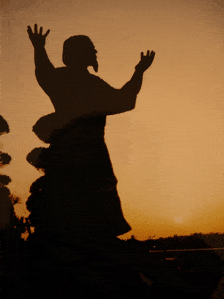
Morihei Ueshiba is the Founder of Aikido. He was born December 14, 1883, in Tanabe, in the Kumano area. He trained hard for numerous years and received deep and precious teachings in martial arts and in the spiritual realm.
He spent all his life fostering the path of harmony—Aikido—and extending it throughout the entire world. Through his teaching, he wanted to bring peace to all humanity. His defining feature was to give Budo the direction of the way of love.
He had a strong bond with the Kumano area and made many spiritual retreats there. He asked Hikitsuchi Sensei to build a Dojo in Shingu. After that, he taught many times in this Dojo.
He died on April 26, 1969. His grave is now in Tanabe, in the Kojan-ji temple area. After his death, he received the name of Aiko no Mikoto (Kami of the shining love).
Michio Hikitsuchi Sensei
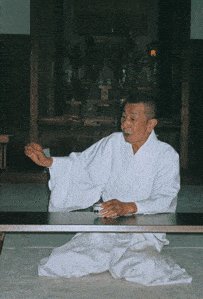
Michio Hikitsuchi Sensei was the Dojo Cho of the Aikido Kumano Juku Dojo.
He was born July 14, 1923, in Shingu, in the Kumano area, Wakayama Prefecture. He followed O Sensei Morihei Ueshiba’s teaching since the age of 14 and had a very close relationship with him. In 1954, he built a Dojo in Shingu at O Sensei’s request.
On January 10, 1969, he received the rank of 10th dan Aikikai Tokyo directly from the hand of O Sensei.
He died on February 2, 2004. He left in the heart of all aikidoists who had met him the imprint of sharp severity and great generosity.
Seeing himself as “the open book of O Sensei”, he kept wide open the doors of his luminous knowledge for all his students in Japan and the world, and they remain deeply grateful to him.
Motomichi Anno Sensei
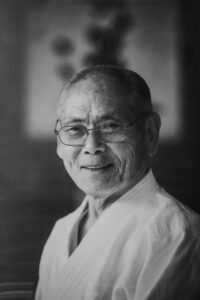
Anno Motomichi Sensei was born on May 14, 1931, in the Kumano region.
At the age of 23, he was admitted to the Kumano Juku Dōjō by Michio Hikitsuchi Sensei. He remained his devoted student until the latter’s passing, a period of 40 years.
Anno Sensei was also, for 15 years, a direct student of Master Ueshiba Morihei, the founder of Aikido, from whom he received the 6th Dan. In 1978, he was awarded the 8th Dan.
From the 2000s onward, he conducted numerous seminars in the United States and Europe. In 2004, following the passing of Hikitsuchi Sensei and at his request, he assumed leadership of the Kumano Juku Dōjō.
In 2015, he founded the Kishu Kumano Aikikai Funada Dōjō. With great generosity, he continued to transmit there the teaching of the Founder, which he had received directly.
On January 12, 2009, Anno Motomichi Sensei received the High Distinction of Martial Arts, awarded by the Nihon Budō Kyōgikai (Japan Martial Arts Association), in recognition of his 55 years devoted to Aikido.
On January 31, 2026, Anno Motomichi Sensei passed away peacefully at his home at the age of 95, after dedicating 73 years of his life to the practice and teaching of Aikido.
His teaching was deeply rooted in the spiritual tradition of the sacred Kumano region. Through his infinite patience and great kindness, he guided many students of all ages and nationalities toward the realization of harmony and love, constantly reminding them of the words of Ō Sensei.
During the last 30 years of his life, Anno Sensei was a profound source of inspiration and a precious spiritual guide for Kunzi Jean-Pierre Sensei. Their relationship had become i shin den shin (a direct, heart-to-heart transmission).
Jean-Pierre Kunzi Sensei
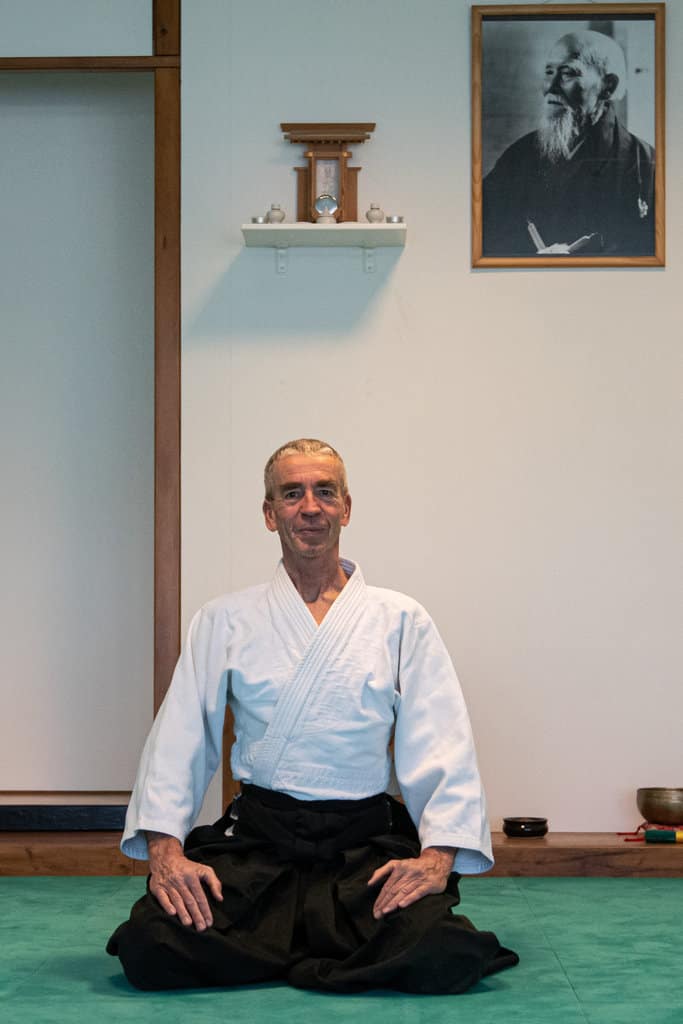
Jean-Pierre Kunzi is the Dojo Cho of the Aikido Geneva Takemusu Dojo. He now holds the rank of 6th dan Aikikai Tokyo.
He has trained many times at the Kumano Juku Dojo in Shingu, Japan. Now, he still receives O Sensei’s teaching through Motomichi Anno Sensei at the Funada Dojo in Japan. With rigor and kindness, Jean-Pierre Kunzi Sensei makes this teaching accessible to his students.
Thanks to his professional experience as a sports teacher since 1983 in Geneva, and as assistant director of a public school for some years, he possesses deep knowledge in pedagogy and human relations.
Instructors assisting Jean-Pierre Kunzi Sensei
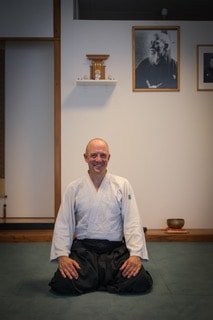
Adrien Jacot-Des-Combes
4th dan, practicing Aikido since 2006, has taken part in two training stays in Japan, works as a teacher with adolescents facing significant academic challenges, has been actively involved for several years as a trainer and supervisor within the Department of Public Education, and also contributes at the University of Geneva as part of continuing education. Teaches Aikido to adults and children. He says:
“Aikido is, to me, a treasure chest. I come to practice regularly without expecting anything specific, and I discover, with wonder, things I didn’t even know existed. My entire life probably won’t be enough to explore all its corners!”
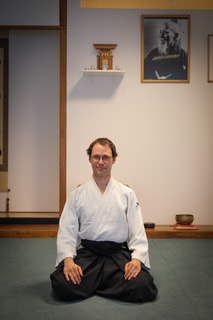
Isaïe Fasel
3rd dan, practicing Aikido since 2012, took part in a training retreat in Japan, works as a teacher, teaches philosophy and French at a secondary school in Geneva (Moser School). Teaches Aikido to adults. He says:
“Aikido, by urging me to let go with each practice, opens the door to treasures of vitality, open-heartedness, and peace. What a truly valuable path, worthy of being shared!”
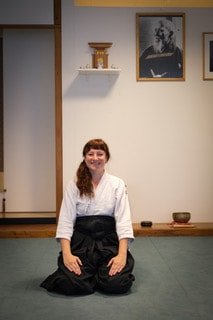
Valeria Repetto
2nd dan, practicing Aikido since 2014, began her practice at Shoshin Aikikai in Singapore, where she trained for a year. Specialized in Chinese and Southeast Asian studies, holds a teaching qualification in English. Born and raised in Italy, lived in Belgium during her studies, then in China and Singapore, before settling in Geneva, primarily due to Aikido. Passionate about languages, she teaches Italian and English at a private institution and teaches at a public primary school in Geneva. Teaches Aikido to adults. She says:
“I view the practice of Aikido as a means of encountering my deepest self. Through constant Aikido practice, I’ve been able to not only understand my fears but also work with them and, in some cases, overcome them. Aikido enables me to live better in my daily life and equips me to face life and my relationships with more clarity, kindness, and harmony. What I love most about this practice is that training never stops and we have a lifetime to keep learning and evolving. In Aikido, we are constantly confronted with ourselves and we continue to journey and grow alongside our fellow practitioners.”
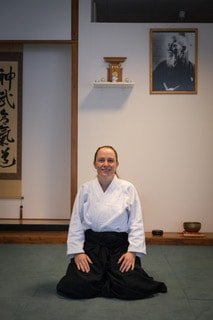
Caroline Collin
2nd dan, practicing Aikido since 2017, participated in a training stay in Japan, originally from Belgium, a psychiatrist by profession, worked as a general practitioner and sports physician, retrained in psychiatry and has a private practice in Geneva. Holds qualifications as a systemic psychotherapist and as a body psychotherapist. Passionate about nature, outdoor activities, sports, and photography. Teaches Aikido to adults and children. She says:
“I have found in Aikido the nobility of an art that grants me access to my inner richness and that of others. This extraordinary discovery motivates me to share it with anyone who wishes to practice with us.”
Answers to the most frequent questions
Why is the Sensei so important?
More than just an instructor, the Sensei transmits the essence of the martial art from Sensei to student or I Shin Den Shin, from my heart to your heart. Basic techniques can be learned from books or videos, but rapid progression can only be achieved with the help of a Sensei (literally, one who is ahead on the path).